Autonomous Floor Scrubbers for SF Janitorial Contractors
Small janitorial contractors in San Francisco face rising labor costs and strict City green-cleaning rules. This guide breaks down how to pilot autonomous floor scrubbers affordably while staying comp
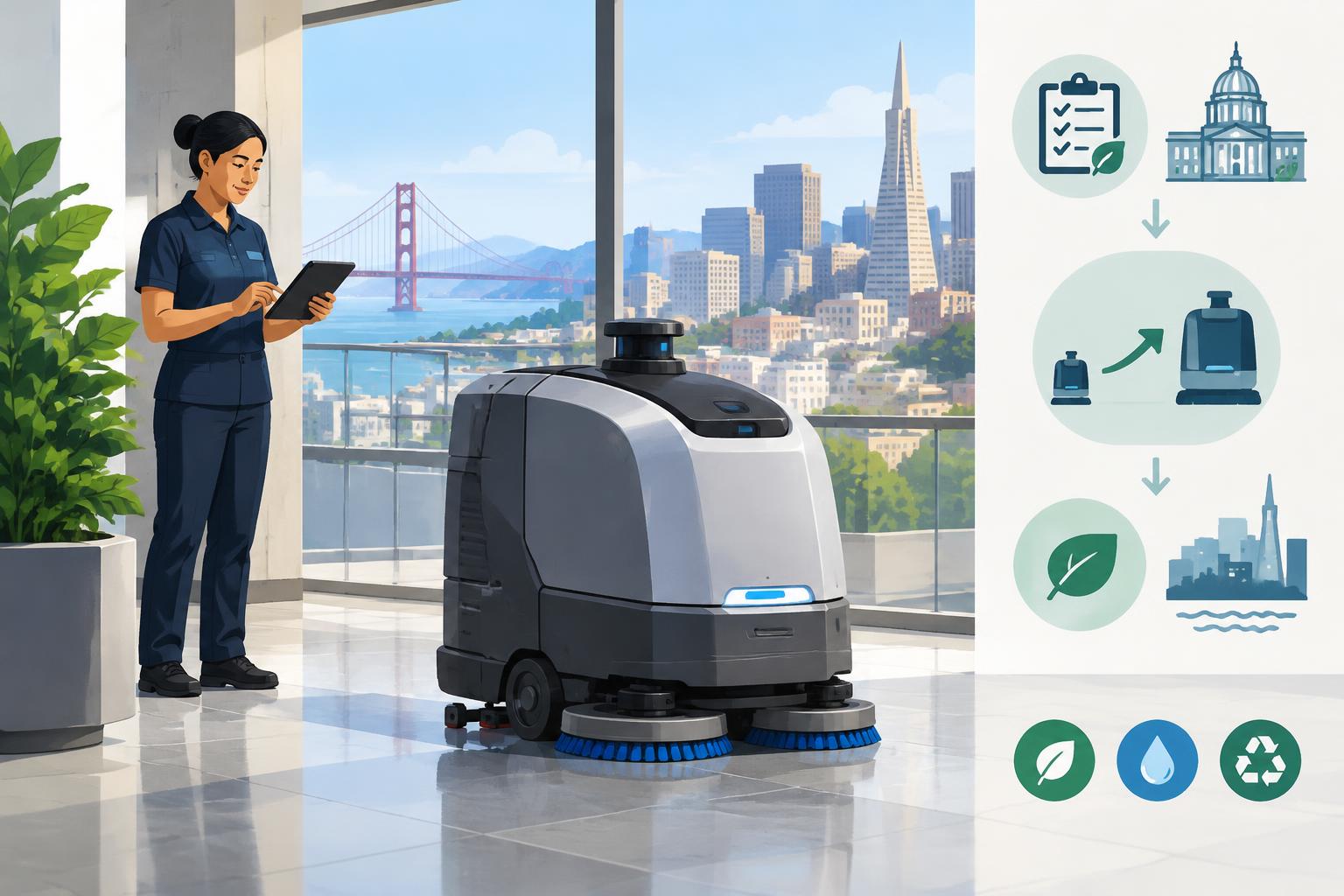
How Small Janitorial Contractors in San Francisco Can Pilot Autonomous Floor Scrubbers Without Breaking the Budget
Running floor care operations in San Francisco's commercial buildings is getting harder. Labor costs are rising, skilled custodial workers are scarce, and City clients increasingly demand documented green-cleaning compliance before signing contracts. For small janitorial contractors, the pressure to do more with the same crew — while staying competitive on price — is real and immediate.
Autonomous floor scrubbers are one practical response. But the technology comes with its own set of decisions: What does it actually cost? Where does it fit? And critically, does it satisfy San Francisco's procurement and green-cleaning rules? This post works through those questions so you can make a grounded choice.
Understanding What Robotic Scrubbers Actually Do (and Don't Do)
Before pricing out equipment, it helps to be clear-eyed about the technology's scope. According to Scrubber Guide's analysis of robotic floor scrubbers, a robotic scrubber uses lidar, cameras, and ultrasonic sensors to map a building, follow a cleaning route, and avoid obstacles — but it does not remove the human from floor care. It changes the job from driving the machine to supervising it.
That distinction matters for staffing. Your crew still handles tank fills, edge work, setup, and any exceptions the robot can't navigate. Think of it as a labor reallocation tool, not a headcount elimination tool.
Where Robots Perform Well — and Where They Struggle
The same source is direct about fit: robots work best on large, open, repeatable floors cleaned daily — think big-box retail, airport corridors, or wide-aisle warehouses. They struggle in small, cluttered, or constantly changing spaces.
For commercial cleaning in San Francisco's dense office towers, post-construction cleaning sites, or move-in and move-out cleaning jobs with shifting floor layouts, a robot may underperform without strong Wi-Fi infrastructure and consistent floor conditions. Assess each account's physical profile before committing equipment to it.
What It Costs to Enter the Market
Budget reality is the first filter for any small contractor. Scrubber Guide's cost breakdown puts the purchase price of a robotic floor scrubber at roughly $35,000 to $80,000+, with monthly subscription options that bundle software and service for operators who prefer to avoid large capital outlays.
In a hypothetical 80,000 sq ft retail account modeled by that source, a robot reduced nightly scrub labor from about 5 hours to about 1 hour. But the analysis is careful to note: savings are only real if freed labor hours are actually redeployed or removed from the schedule. If your crew simply idles during the robot's run, the ROI calculation collapses.
Subscription vs. Purchase: A Decision for Small Contractors
For a small janitorial business piloting its first autonomous unit, a subscription or lease structure reduces upfront risk and often includes software updates and maintenance — costs that are easy to underestimate on a purchased machine. Run the numbers against your specific account volume before choosing a model. One large, stable commercial cleaning account in San Francisco may justify ownership; a varied portfolio of shorter-term jobs may not.
Matching Equipment to San Francisco's Green-Cleaning Rules
Owning the right machine is only half the compliance picture. Any contractor bidding on San Francisco City contracts — or working with tenants in City-leased buildings — must use cleaning products that meet the City's approved standards.
The SF Approved green purchasing portal lists general-purpose cleaners that qualify under three main certification tiers: US EPA Safer Choice, UL Ecologo, and Green Seal. City-approved vendors including Starline Supply, Waxie, and United Labs carry qualifying products. Using a robotic scrubber loaded with a non-approved solution — even a familiar brand — can disqualify a bid or trigger a contract compliance issue.
Pairing Autonomous Equipment with Green Chemistry
The good news is that most modern autonomous scrubbers are designed for chemical dilution systems that work cleanly with concentrated, certified solutions. Spec your chemical program at the same time you evaluate equipment, not after. Confirm that your chosen cleaner carries at least one of the certifications listed on the SF Approved portal before finalizing supplier agreements.
This alignment also strengthens your pitch to private-sector clients. San Francisco Environment's green cleaning resources note that green cleaning products and practices can result in up to 70% reduction in employee chemical exposure — a credible, sourced talking point when competing for health-conscious office cleaning accounts in San Francisco.
Building a Pilot That Can Actually Scale
A pilot that works on one account is only valuable if it generates transferable lessons. Structure yours to produce data you can use elsewhere.
Start with your largest, most geometrically consistent account — ideally one with stable overnight access and reliable Wi-Fi. Document baseline labor hours for floor care before the robot arrives, then track actual hours for the first 60–90 days of operation. Include setup time, supervision time, and any manual touch-up. That comparison is the honest ROI number you'll take to the next client conversation.
Scaling Considerations Specific to San Francisco
San Francisco's mix of older commercial buildings, earthquake-retrofit construction zones, and high-density office floors creates real variability in deployment conditions. Freight elevator access, building management system requirements, and noise ordinances in mixed-use neighborhoods can all affect your robot's operating window.
As you scale from one account to two or three, these operational details compound. Build a simple pre-deployment checklist that covers Wi-Fi strength, floor surface type, obstacle density, and after-hours access protocols. That checklist becomes a repeatable qualification process — and a professional differentiator when you're bidding floor care San Francisco contracts against competitors who haven't thought through the logistics.
Next Steps for Your Contracting Business
Autonomous floor scrubbers are a viable path for small janitorial contractors in San Francisco willing to invest in piloting carefully, pairing equipment with compliant chemistry, and measuring results honestly. The technology won't solve every floor care challenge, and it won't make sense for every account — but for the right jobs, it can meaningfully shift your labor equation and strengthen your competitive position.
If you're evaluating autonomous equipment for your commercial cleaning operations in San Francisco or want help thinking through green-cleaning compliance for City procurement, reach out to C&A Janitorial Service Inc. A direct conversation about your specific accounts and service mix is the fastest way to determine whether this technology makes sense for your business right now.
About this illustration
This editorial image was created with AI. It is not a photograph of an actual customer, property or completed service.