Autonomous Floor Scrubbers: A Guide for SF Janitorial Contractors
Small janitorial contractors in San Francisco can now realistically pilot autonomous floor scrubbers—if they sequence the buying, compliance, and scaling decisions correctly. Here's a practical framew
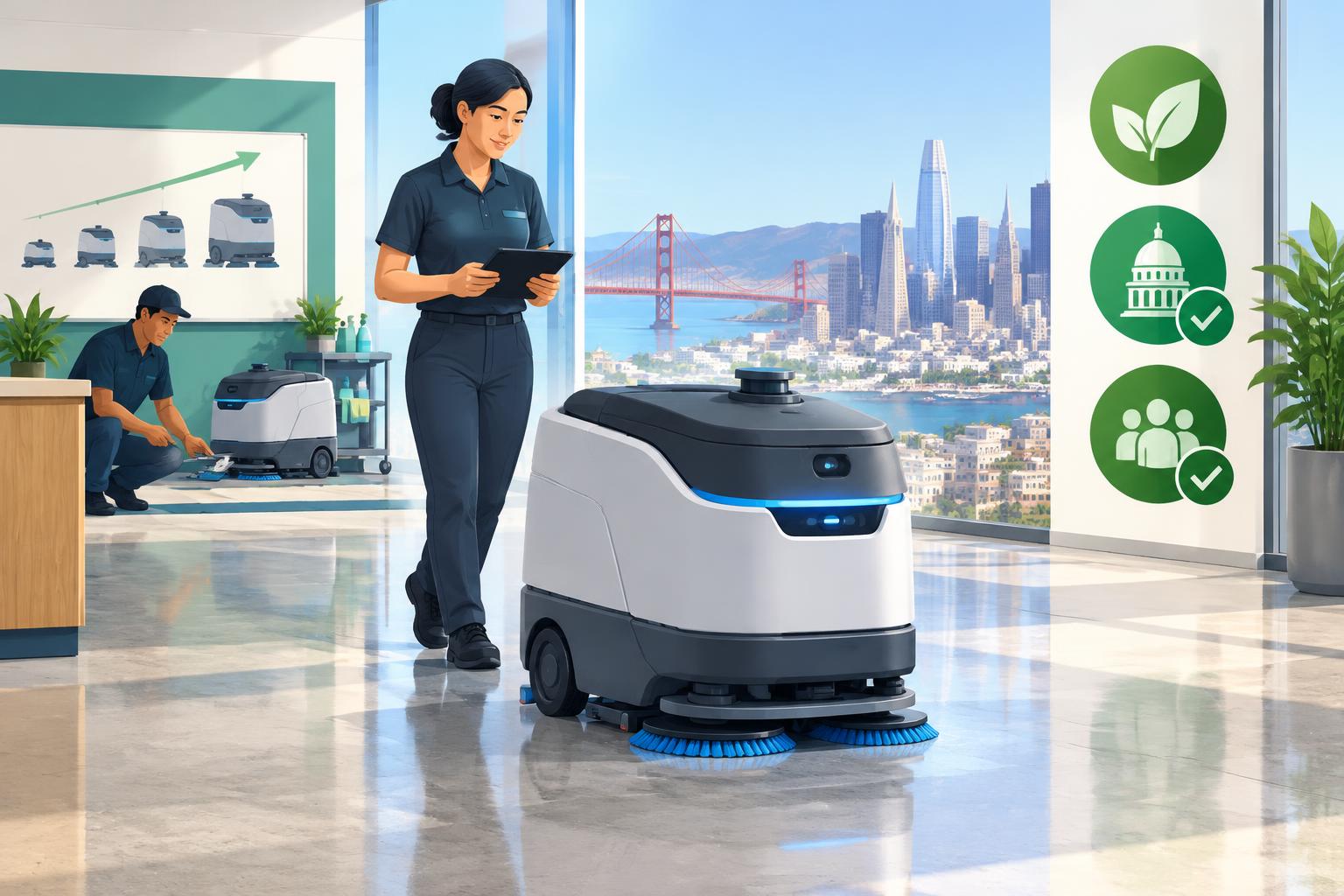
How Small Janitorial Contractors in San Francisco Can Pilot and Scale Autonomous Floor Scrubbers—Without Running Afoul of Green-Cleaning Rules
Most small janitorial businesses don't pilot new technology because the risk feels disproportionate. A machine that sits idle or fails a city compliance check costs money a tight-margin operation can't afford. But robotic floor scrubbers have matured enough that a structured pilot is now a realistic option—if you sequence the decisions correctly.
This guide is written for owner-operators running floor care in San Francisco, CA who want to test autonomous scrubbers at one or two sites before committing to a fleet.
Why Autonomous Scrubbers Are No Longer Just for Big Retailers
The Walmart deployment in 2018 put autonomous floor scrubbers on the map, but that rollout involved hundreds of locations and a large technology partner. The situation for smaller operators is different today. As Cleaning & Maintenance Management reports, advances in sensors, AI navigation, and ease of use have steadily lowered the barrier to entry: "Today there are thousands of 'intelligent cleaners' deployed globally in retail and grocery stores, malls, airports, schools, hospitals, and other public locations."
The lesson for a small contractor is not that you need Walmart's budget—it's that the technology has been stress-tested in high-traffic, unforgiving environments. The question shifts from "does it work?" to "which configuration fits my client mix and contract structure?"
The Platform-vs.-Machine Buying Decision
One practical complexity worth understanding before you sign anything: some autonomous scrubber programs are actually two-company products. For example, as documented by Scrubber Guide, Brain Corp's BrainOS platform supplies the autonomous navigation layer while the physical machine comes from a separate manufacturer like Tennant. That means you may be negotiating warranties, software subscriptions, and hardware service from different vendors.
Before a pilot, clarify in writing which company handles each category of failure—machine, software, mapping—and what the escalation path looks like. This is a due-diligence step that larger buyers sometimes skip and small contractors genuinely cannot afford to.
Structuring a Pilot That Protects Your Margins
A pilot should answer two questions: Does the machine reduce labor hours on this specific floor type, and does it integrate cleanly with your existing staffing model? Neither question can be answered by a vendor demo alone.
Pick one site where you already have a multi-month contract and can absorb some learning curve. Log labor hours, cleaning pass quality, and any incident reports for at least 60–90 days before drawing conclusions. Hypothetically, a contractor running 8,000 square feet of nightly commercial cleaning might find that a robotic scrubber handles flat open areas efficiently while staff redirects to detail work around fixtures—but your actual results will depend on floor layout, soil load, and client expectations.
Leasing vs. Buying for the First Unit
For a first pilot, leasing or a rental-to-own arrangement typically makes more financial sense than an outright purchase. Leasing preserves working capital, converts an unpredictable capital expense into a predictable monthly cost, and gives you an exit if the machine doesn't fit your workflow. Confirm that any lease agreement doesn't lock you into software-upgrade fees that escalate faster than your contract revenue.
Meeting San Francisco's Green-Cleaning and Procurement Standards
Autonomous scrubbers reduce labor time, but they don't operate in a chemical vacuum. The cleaning solutions you run through them still need to meet San Francisco's procurement standards—and the city's requirements are specific.
The City's SF Approved green-cleaning list identifies accepted certifications for general-purpose cleaners: US EPA Safer Choice, UL Ecologo, Green Seal, and Cradle to Cradle Gold. If you hold or are pursuing a contract with any city department or city-adjacent facility, using products outside these categories is not a gray area—it's a compliance failure. Stock your pilot machine with solutions already on that approved list and document each product by certification tier.
The Healthier, Cleaner, Quieter Communities Act: What It Means for Floor Equipment
San Francisco's Healthier, Cleaner, Quieter Communities Act, which went into effect July 1, 2024, bans the use of gas-powered small off-road engines (SOREs) by city departments and their contractors on contracts beginning after that date. Most commercial floor scrubbers are electric and not directly affected—but the ordinance signals the direction of city procurement policy broadly.
If you are bidding on city contracts and your equipment inventory includes any gas-powered pressure washers, generators, or landscaping tools, those are now disqualifying. Electric autonomous scrubbers align naturally with this trajectory and can be positioned as a compliance asset—not just an efficiency tool—when you're competing for city-adjacent commercial cleaning in San Francisco, CA.
Scaling Beyond the Pilot: When a Second Machine Makes Sense
Once your pilot site shows consistent labor-hour savings and your staff is comfortable with route mapping and basic troubleshooting, the case for a second machine rests on client density, not enthusiasm. A second unit only makes financial sense if you have enough floor square footage across clients to keep it utilized at least five nights per week.
Map your current client list by total cleanable floor area and assess which locations have the open floor plans that autonomous scrubbers handle best. High-turnover environments like post-construction cleaning in San Francisco, CA—where dust and debris loads are heavy and layouts are still being finalized—may require more manual oversight and aren't ideal early candidates. Established office environments with predictable soil loads are better starting points for scaling.
Documenting ROI for Future Bids
Keep a clean record of labor hours before and after deployment, chemical usage per square foot, and any client satisfaction notes. This documentation serves two purposes: it tells you whether scaling is genuinely profitable, and it becomes a differentiator in competitive bids. A small janitorial services contractor in San Francisco that can show a prospective client measurable efficiency data and a documented green-cleaning protocol is operating at a different credibility level than one that can only describe its services verbally.
Ready to Upgrade Your Floor Care Program?
If you're evaluating robotic scrubbers for your cleaning operation, or if you need a janitorial partner in San Francisco who already understands the city's green-cleaning requirements, C&A Janitorial Service Inc is available to discuss your facility's needs. Reach out directly to talk through your current floor care program, compliance questions, or upcoming contracts—no obligation, just a straightforward conversation about what would actually work for your space.
About this illustration
This editorial image was created with AI. It is not a photograph of an actual customer, property or completed service.