Autonomous Floor Scrubbers: A Guide for Small SF Janitorial Contractors
Small janitorial contractors in San Francisco can pilot autonomous floor scrubbers without overcommitting capital — if they plan carefully and stay compliant with city procurement and labor rules.
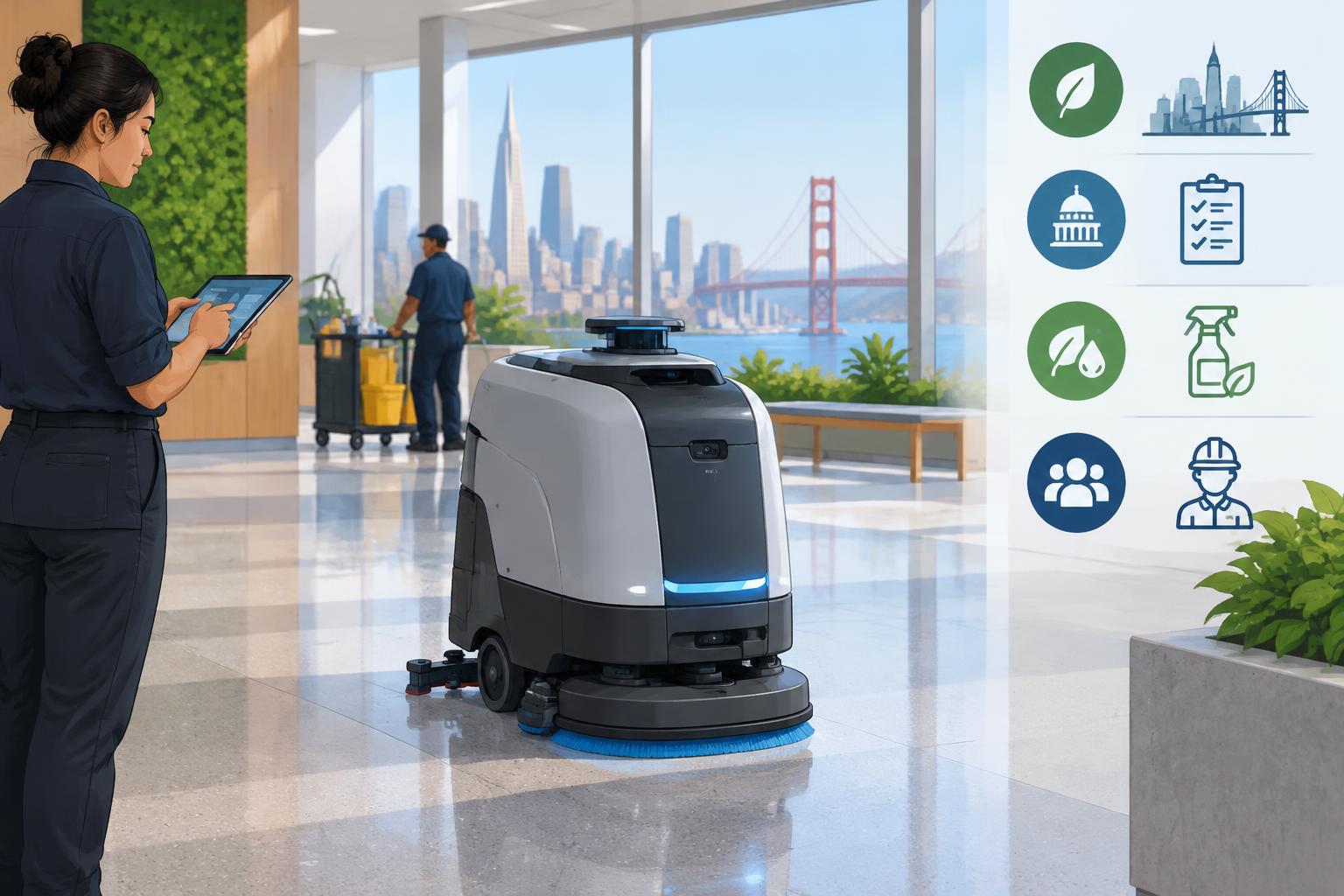
Running a small janitorial operation in San Francisco means competing on both quality and cost — often simultaneously. Labor is expensive, skilled floor-care technicians are hard to retain, and clients increasingly expect documented green-cleaning compliance alongside spotless results. For contractors already stretched thin, adding autonomous floor-scrubbing equipment to the mix can feel like a gamble rather than a growth strategy.
But the question isn't whether robotic floor care is coming to commercial cleaning in San Francisco, CA — it's how small contractors can adopt it without overextending their capital or falling afoul of the city's procurement and labor rules.
Why Floor Care Is the Right Place to Start with Automation
Not every janitorial task is a strong candidate for automation. Window cleaning, detail work, post-construction cleaning, and move-in and move-out cleaning all demand human judgment and adaptability. Floor scrubbing is different: it is high-frequency, physically demanding, and highly repetitive across predictable surface areas.
Autonomous scrubbers navigate fixed floor plans, execute consistent cleaning paths, and log real-time performance data — exactly the kind of documentation that satisfies both facility managers and compliance auditors. For a small contractor offering floor care in San Francisco, CA, this makes automated scrubbing one of the lowest-risk places to begin a technology pilot.
The operational case is also building in the broader industry. A case study published by Pringle Robotics details how a national convenience store chain successfully deployed over 1,200 autonomous floor-cleaning robots across all its locations during 2024 and 2025. Key takeaways from the project include the importance of phased rollouts, hands-on staff training, and close collaboration between the equipment provider and the cleaning team — lessons directly applicable to small contractors considering their first pilot unit.
How to Structure a Pilot That Doesn't Overcommit Your Business
Start with One Client Site, Not Your Entire Portfolio
A common mistake is treating a technology pilot as a full product launch. Pick a single client location with a large, open floor area — a warehouse anteroom, a ground-floor lobby, or a wide commercial corridor — and run the robot alongside your existing crew for 30 to 60 days. This gives you real performance data without disrupting your broader service commitments.
Define Success Before You Deploy
Before the pilot begins, agree internally on what "working" looks like: square footage cleaned per shift, chemical consumption, technician time freed up, and client satisfaction scores. Without predefined benchmarks, it's easy to declare a pilot a success (or failure) based on feeling rather than evidence. The Pringle Robotics case study notes that results reflecting increased efficiency, ROI, and employee satisfaction were traceable precisely because the project tracked them systematically from the start.
Plan for Environmental Adaptations
Real commercial spaces are messier than showrooms. Obstacles shift, floors get wet from other tasks, and elevator thresholds can trip navigation systems. Budget time — not just money — for troubleshooting these adaptations during the pilot phase. What you learn in weeks two and three of a pilot is usually more valuable than what you learn in week one.
Navigating San Francisco's Procurement and Labor Environment
San Francisco's administrative structure places significant responsibility on department heads and appointing officers for how contracts are structured and how workers are classified. The San Francisco Administrative Code outlines the civil service and procurement framework that governs city-adjacent contracts and purchasing decisions — relevant to any janitorial contractor working in publicly funded or city-leased facilities.
For small contractors, this matters in two practical ways. First, equipment purchases or leases above certain thresholds may require documented procurement processes if your client is a city department or public institution. Second, how you deploy a robot alongside your existing crew — and how that changes individual employee workloads — can intersect with labor agreements and San Francisco's minimum wage and scheduling ordinances.
Green-Cleaning Compliance Is Not Optional
San Francisco has long maintained green-cleaning requirements for facilities that fall under city oversight, and many private commercial tenants now mirror those standards voluntarily. When evaluating autonomous scrubbers, confirm that the cleaning solution compatibility, water usage metrics, and chemical dilution controls meet California's Green Seal or similar recognized standards. Autonomous equipment that optimizes chemical use is often easier to certify as green-compliant than manual processes — but you need the documentation to prove it.
Protect Your Workers, Not Just Your Margins
Introducing a scrubber does not mean reducing headcount should be your first move. Redeployment — moving technicians from repetitive floor scrubbing to higher-skill tasks like detail cleaning, window cleaning, or post-construction cleaning — is both more defensible under labor rules and better for long-term crew retention. San Francisco's labor market rewards contractors who invest in their teams, and clients notice the difference.
Scaling from One Unit to a Small Fleet
If your pilot produces solid, documented results, the path to scaling is more straightforward than it appears. The Pringle Robotics case study demonstrates that a phased, location-by-location approach — rather than a simultaneous fleet-wide rollout — reduces operational risk and allows training protocols to improve with each new deployment.
For a small janitorial contractor, "scaling" might mean two or three units across your top accounts, not hundreds. That's a realistic and financially manageable goal. At that size, you can negotiate favorable lease terms, standardize your maintenance schedule, and build a genuine operational differentiator in a crowded market for commercial cleaning in San Francisco, CA.
Keep your documentation current at every stage: cleaning logs, chemical usage reports, client sign-offs, and any city compliance records. This paper trail is what allows you to bid on larger facility contracts with confidence — and to defend your practices if they are ever reviewed.
Building a Reputation That Outlasts Any Single Piece of Equipment
Autonomous floor care is a tool, not a business model. The contractors who will benefit most from this technology are the ones who already have strong client relationships, disciplined operations, and a clear understanding of what their crews do best. Equipment accelerates good processes; it cannot substitute for them.
Whether your work centers on office cleaning, post-construction cleanup, move-in and move-out turnovers, or ongoing floor care in San Francisco, CA, the fundamentals remain the same: show up consistently, communicate clearly, document everything, and comply with every applicable rule.
Ready to Explore Floor Care Solutions for Your San Francisco Facility?
If you manage a commercial property or facility in San Francisco and want to discuss what modern floor-care services — including emerging automated options — could look like for your building, reach out to C&A Janitorial Service Inc directly. A conversation costs nothing, and the right cleaning partner will help you understand your options honestly before any commitment is made.
About this illustration
This editorial image was created with AI. It is not a photograph of an actual customer, property or completed service.