Floor Robotics for Small Janitorial Contractors: A Practical Pilot Guide
Small janitorial contractors face growing pressure to adopt floor robotics, but buying equipment before building a program is the most common — and costly — mistake. Here's how to pilot smart and scal
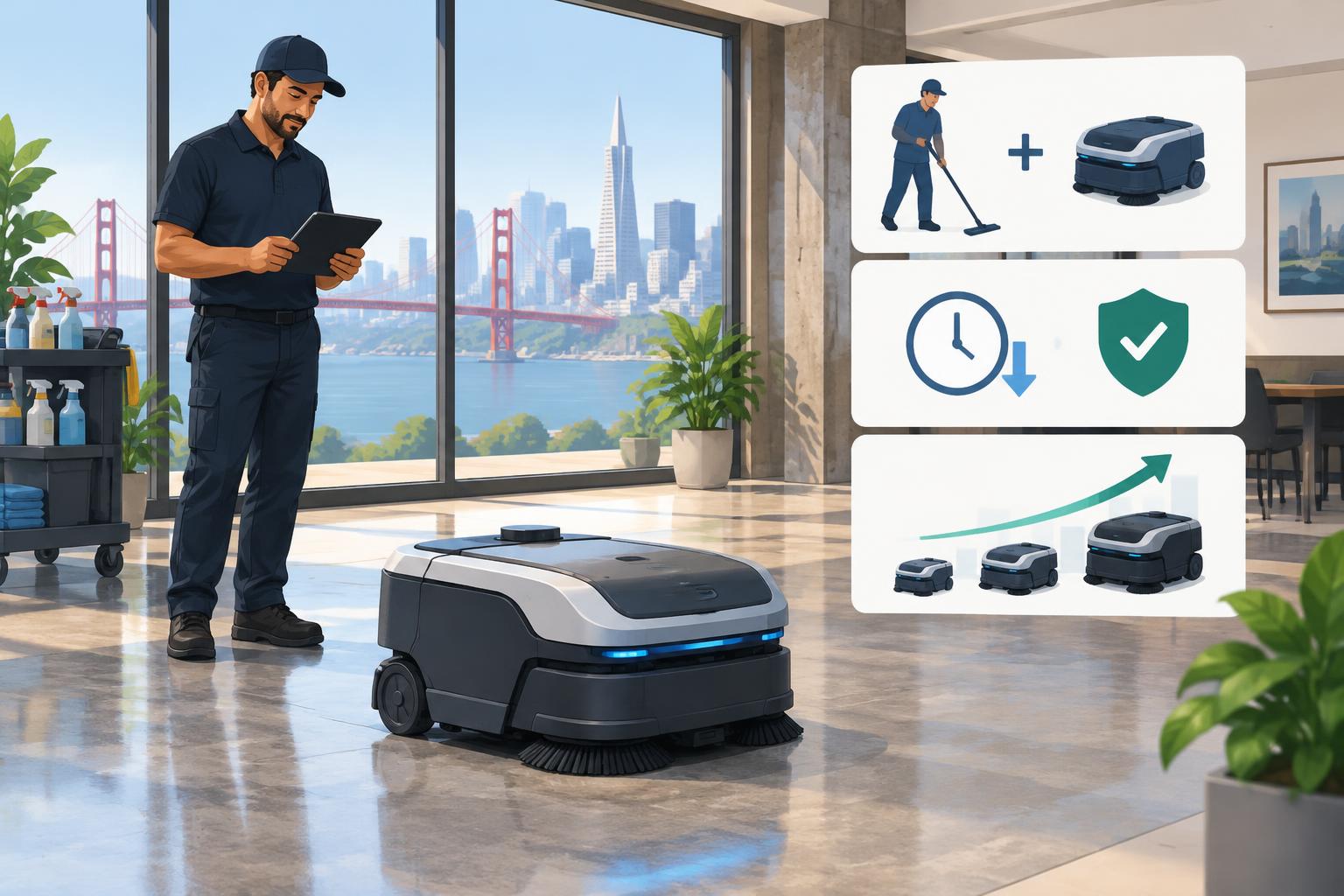
The Robot in the Closet Problem
A familiar scene is playing out in facility closets across the country: a robotic floor scrubber, still in near-mint condition, parked beside the mop bucket it was supposed to replace. According to reporting from ISSA, the number of companies showing robotic floor equipment at major industry events grew from roughly a dozen to nearly 50 in just one year. Commoditization moved faster than deployment know-how, and many units now gather dust because someone bought the tool before solving the underlying operational problem.
For small building service contractors — the kind doing floor care in San Francisco, CA for offices, post-construction sites, and move-in/move-out turnovers — that cautionary tale is worth taking seriously before signing any lease or purchase agreement. The upside is real, but only if the program around the robot is built first.
Why Labor Pressure Is Making Robotics Hard to Ignore
The financial case for floor automation is sharpening fast. Nassco's review of 2026 industry research found that roughly 32% of building service contractors plan to adopt robotic floor equipment within the next 12 months — approximately double the share from 2025. At the same time, 44.6% of contractors expect labor challenges to increase, and 72.5% anticipate rising wage demands.
For commercial cleaning in San Francisco, CA, where operating costs are already elevated, those pressures land with particular weight. A robot that handles repetitive large-floor scrubbing or buffing can free a trained technician to focus on detail work — restrooms, glass surfaces, high-touch points — where human judgment and dexterity still outperform any machine on the market.
The same Nassco research noted that among contractors evaluating autonomous equipment, 77% cited labor savings as a primary purchase influence, and roughly 70% expected payback within two years. Those are reasonable benchmarks, but they assume the equipment is actually running — not parked.
Build the Program Before You Buy the Robot
The clearest lesson from contractors who have successfully scaled robotics is one worth repeating: the robot is a tool inside a program, not the program itself. Start with the operational problem you're trying to solve, then evaluate whether a robot is the right tool for it.
For a small contractor offering janitorial services in San Francisco, CA, that means asking concrete questions before any purchase: Which floor types do your current contracts include? What square footage per shift would justify automation? Do your client sites have layouts — open corridors, consistent surface types — that a robot can actually navigate without constant supervision?
A useful pre-pilot checklist might include:
Assess Site Suitability First
Not every floor plan suits autonomous equipment. Open, obstacle-light environments — large office lobbies, warehouse floors, retail spaces — tend to yield the fastest productivity gains. Cluttered layouts, tight corridors, or mixed hard/soft flooring zones are better served by skilled manual labor, at least in an early pilot phase.
Start With One Machine on One Site
Resist the temptation to deploy across your whole account list at once. A single robot on a single high-square-footage account lets you measure actual labor-hour reduction against baseline, identify mapping and maintenance needs, and train staff without disrupting multiple client relationships simultaneously.
Train Staff as Robot Operators, Not Replacements
The ISSA reporting cited above makes a point worth internalizing: successful programs require people who know how to supervise, remap, and maintain the equipment. Positioning your team as skilled robot operators — rather than workers being replaced — reduces turnover risk and builds internal expertise that competitors without a training culture will struggle to replicate.
Protecting Workmanship Quality During the Transition
Automation introduces a new quality-control gap that small contractors often underestimate. A robot scrubbing 15,000 square feet per shift doesn't inspect its own work. Edge zones, corners, and transitions between floor types frequently require manual follow-up, and if that follow-up isn't built into the workflow, client satisfaction erodes quietly until a contract is at risk.
Build a post-robot inspection step into every shift from day one. Assign a technician to walk edges and high-visibility areas after each autonomous run, documenting results with photos where possible. This habit protects your workmanship reputation and gives you the quality data needed to renegotiate or expand contracts as your robotics program matures.
For specialized work — post-construction cleaning in San Francisco, CA where debris loads are unpredictable, or move-in/move-out cleaning where surface conditions vary dramatically — human-led crews should remain the primary resource. Reserve robotics for the repeatable, high-volume floor maintenance that follows initial deep cleans, not the deep cleans themselves.
Scaling From Pilot to Portfolio
Once a single-site pilot demonstrates measurable labor-hour savings and maintained quality scores, scaling becomes a repeatable process rather than a gamble. The key is documenting everything from the pilot: setup time, mapping adjustments, consumable costs (pads, solution), maintenance hours, and client feedback.
That documentation becomes your internal playbook. It tells you which account types are good candidates for expansion, what training a new operator needs, and how to price robotic-assisted contracts competitively without underselling the labor efficiency you've built.
Scaling also means revisiting your service mix. If robotics free up technician hours on large-floor accounts, those hours can be redeployed toward higher-margin specialty work — detailed office cleaning inspections, periodic window cleaning, or hard-surface restoration services that require skill and can command a premium.
Ready to Build a Smarter Floor Care Program?
If you're weighing whether robotic floor equipment makes sense for your accounts — or you need a reliable partner for commercial floor care, post-construction cleanup, or recurring janitorial services in the San Francisco, CA area — reach out to C&A Janitorial Service Inc directly. A brief conversation about your current floor plan types, shift schedules, and contract mix is all it takes to start mapping a practical path forward.
About this illustration
This editorial image was created with AI. It is not a photograph of an actual customer, property or completed service.