Win Commercial Cleaning Contracts With Outcome-Based SLAs
Outcome-based SLAs, cleaning data, and hybrid staffing are reshaping how San Francisco facility managers evaluate janitorial vendors. Here's what to demand—and why it matters for your next contract.
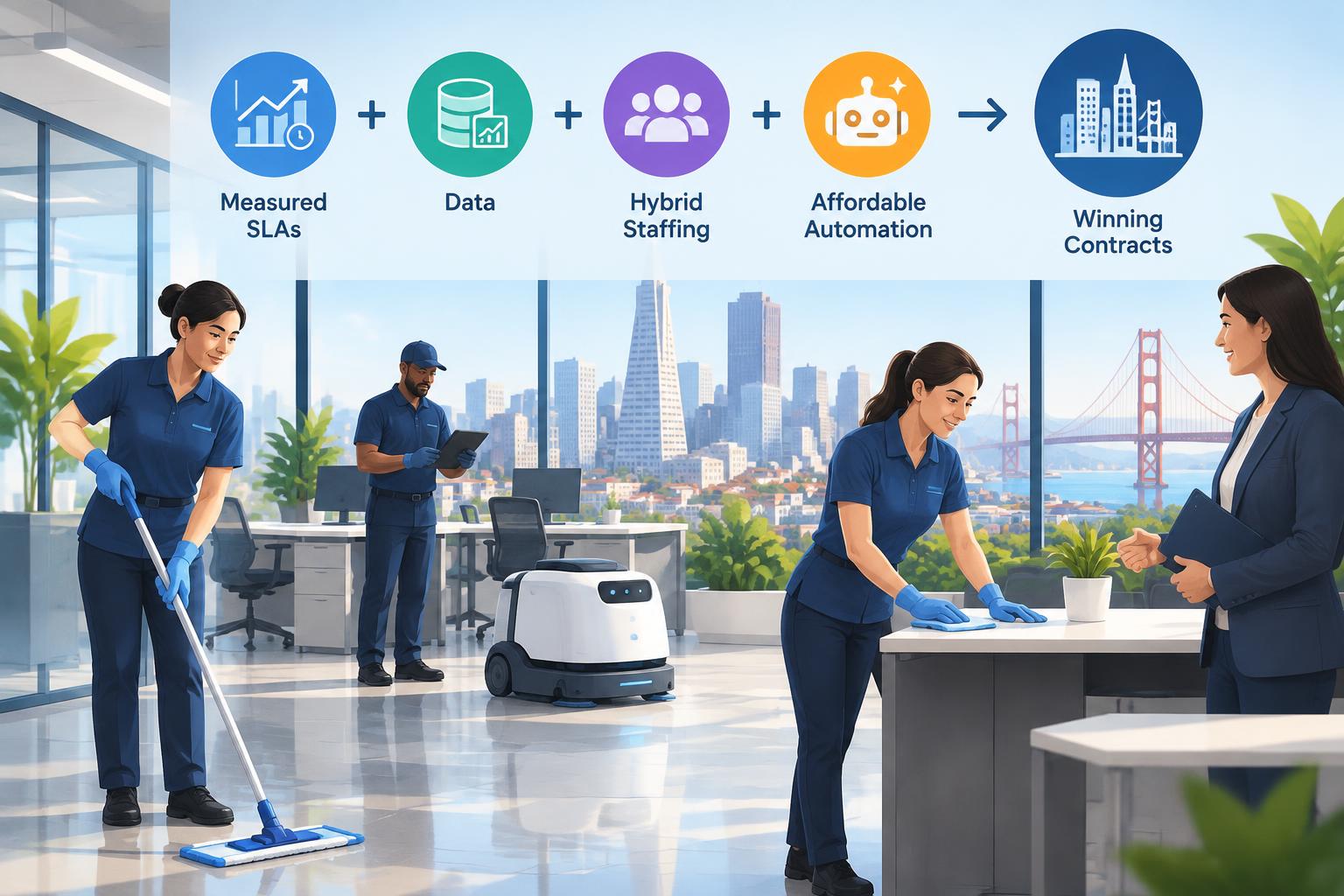
How San Francisco Businesses Can Win—and Keep—Commercial Cleaning Contracts With Outcome-Based SLAs
Facility managers in San Francisco are under measurable pressure. According to the JLL Global State of Facilities Management Report 2025, 84% of facilities leaders cite escalating operating costs and budget constraints as their top concern—and cleaning contracts are squarely in the crosshairs when budgets tighten. The vendors who survive that scrutiny aren't the ones with the lowest price; they're the ones who can demonstrate results.
If you're a property manager, office administrator, or procurement lead evaluating janitorial services in San Francisco, CA, the shift from input-based contracts ("we clean three nights a week") to outcome-based agreements ("high-touch surfaces will meet X hygiene standard by Y time") changes who holds the leverage. This post explains what that shift looks like in practice and what to look for—or demand—from your next cleaning provider.
What "Outcome-Based" Actually Means for Office Cleaning
Inputs vs. Outcomes: A Useful Distinction
Most legacy cleaning contracts specify labor hours, visit frequency, and a task checklist. That tells you what a crew does, not what condition your facility is in. An outcome-based contract, by contrast, anchors the agreement to verifiable end states: surface cleanliness scores, complaint response windows, or inspection pass rates.
The practical difference matters when something goes wrong. With an input-based contract, a vendor who showed up and mopped the floor has technically fulfilled their obligation—even if the floor still looks dirty. With a measured SLA, the obligation isn't discharged until the outcome is confirmed.
Service Level Agreements That Hold Up
A well-written SLA for office cleaning in San Francisco, CA should define at minimum: which surfaces qualify as "high-touch" (door handles, elevator buttons, shared equipment), cleaning frequency for each tier, inspection methodology, and a defined remedy if standards aren't met. Without a remedy clause—a re-clean window, a credit, or a documented escalation path—the SLA is aspirational rather than contractual.
Using Data to Validate (and Renegotiate) Cleaning Standards
What Good Cleaning Data Looks Like
Data doesn't have to mean expensive sensors. Structured inspection logs, timestamped photo documentation, and regular ATP (adenosine triphosphate) surface tests are all practical tools. The CDC's guidance on when and how to clean and disinfect a facility reinforces a tiered approach: high-touch surfaces warrant more frequent attention and, where appropriate, disinfection—not just cleaning. Mapping that guidance to a documented frequency schedule gives both the vendor and the client a shared language for evaluating compliance.
Turning Logs Into Leverage
For facility managers, cleaning data serves two strategic purposes. First, it creates an audit trail that protects you if a hygiene-related liability question ever arises. Second, it gives you objective grounds to renegotiate scope at contract renewal—either to reduce cost where frequency can be safely reduced, or to expand it where traffic data shows higher demand. A vendor who refuses to participate in any measurement framework is signaling something worth noting before you sign.
Hybrid Staffing: Matching Labor to Load
Why Static Staffing Models Break Down
A fixed crew size calibrated to Monday-morning occupancy is almost always either over-resourced on light days or under-resourced during high-traffic periods. Hybrid staffing—combining a core team for routine coverage with on-call capacity for surge demand—aligns labor costs more precisely to actual conditions. For commercial cleaning in San Francisco, CA, where building occupancy can swing sharply based on remote-work policies or seasonal patterns, this flexibility is especially relevant.
What to Ask a Prospective Vendor
When evaluating a janitorial provider, ask directly: How do you adjust staffing when a tenant hosts a large event or a floor gets a full renovation? What's the lead time for surge coverage? A provider with documented surge protocols—and a staffing bench to back them up—is structurally better positioned to maintain SLA compliance than one locked into a fixed-headcount model.
Affordable Automation: Where Technology Adds Real Value
Tools That Make Economic Sense Today
The JLL report notes that AI adoption is accelerating across the facilities management industry and that technology is being used to enhance automation and workflow efficiencies. For cleaning contractors, this doesn't necessarily mean robotic floor scrubbers on day one. More accessible starting points include route-optimization software that reduces labor hours per square foot, digital inspection checklists that flag missed tasks in real time, and QR-code-based feedback systems that let building occupants report issues immediately.
Automation as a Differentiator, Not a Gimmick
The value of affordable automation in a commercial cleaning context is primarily operational: it reduces re-work, shortens response times, and generates the documentation that outcome-based contracts require. A provider who uses even basic digital tools to track completion—rather than paper logs filed weekly—can produce accountability evidence far more readily when a client questions whether a standard was met. That's a tangible competitive advantage in a market where differentiation on price alone is a race to the bottom.
Matching the Right Service Scope to Your Facility's Needs
Beyond Routine Janitorial Coverage
Not every facility need fits neatly into a recurring janitorial contract. Post-construction cleaning in San Francisco, CA requires a different skill set and chemical protocol than nightly office maintenance—construction dust, adhesive residues, and debris require specialized equipment and sequencing. Similarly, move-in and move-out cleaning for commercial tenants involves a defined scope with hard completion deadlines tied to lease dates.
Floor care and window cleaning are two additional categories where frequency and method vary dramatically by surface type and exposure. Polished concrete, VCT tile, and carpet each require different maintenance cycles and products. Exterior and interior window cleaning schedules depend on building height, access equipment, and local air quality conditions. Bundling these services under a single provider with documented SOPs for each can simplify contract management and create clearer accountability.
Aligning Scope to Occupancy Reality
The single most common source of cleaning contract friction is a scope that was written for a building's original occupancy and never updated. If your headcount, lease configuration, or use pattern has changed, your cleaning scope should be reviewed accordingly. An outcome-based framework makes this conversation easier: if the data shows a floor is consistently passing inspection with fewer visits, that's an evidence-based case for scope adjustment—not an argument based on gut feeling.
Ready to Build a Cleaning Contract That Works for Your Facility?
If your current janitorial contract is built on task lists and goodwill rather than measurable outcomes, now is a practical time to revisit it. C&A Janitorial Service Inc. provides commercial cleaning and janitorial services across San Francisco, CA, with the flexibility to support outcome-based agreements, documented inspection protocols, and service scopes that match your facility's actual needs—from routine office cleaning to post-construction and specialty floor care.
Reach out to C&A Janitorial Service Inc. to discuss your facility's requirements and get a service proposal built around results, not just hours.
About this illustration
This editorial image was created with AI. It is not a photograph of an actual customer, property or completed service.