Win More Office Cleaning Contracts in San Francisco
Small janitorial contractors can win more commercial cleaning contracts by pairing measurable SLAs with affordable documentation tools. Here's how to compete on outcomes, not just price, in San Franci
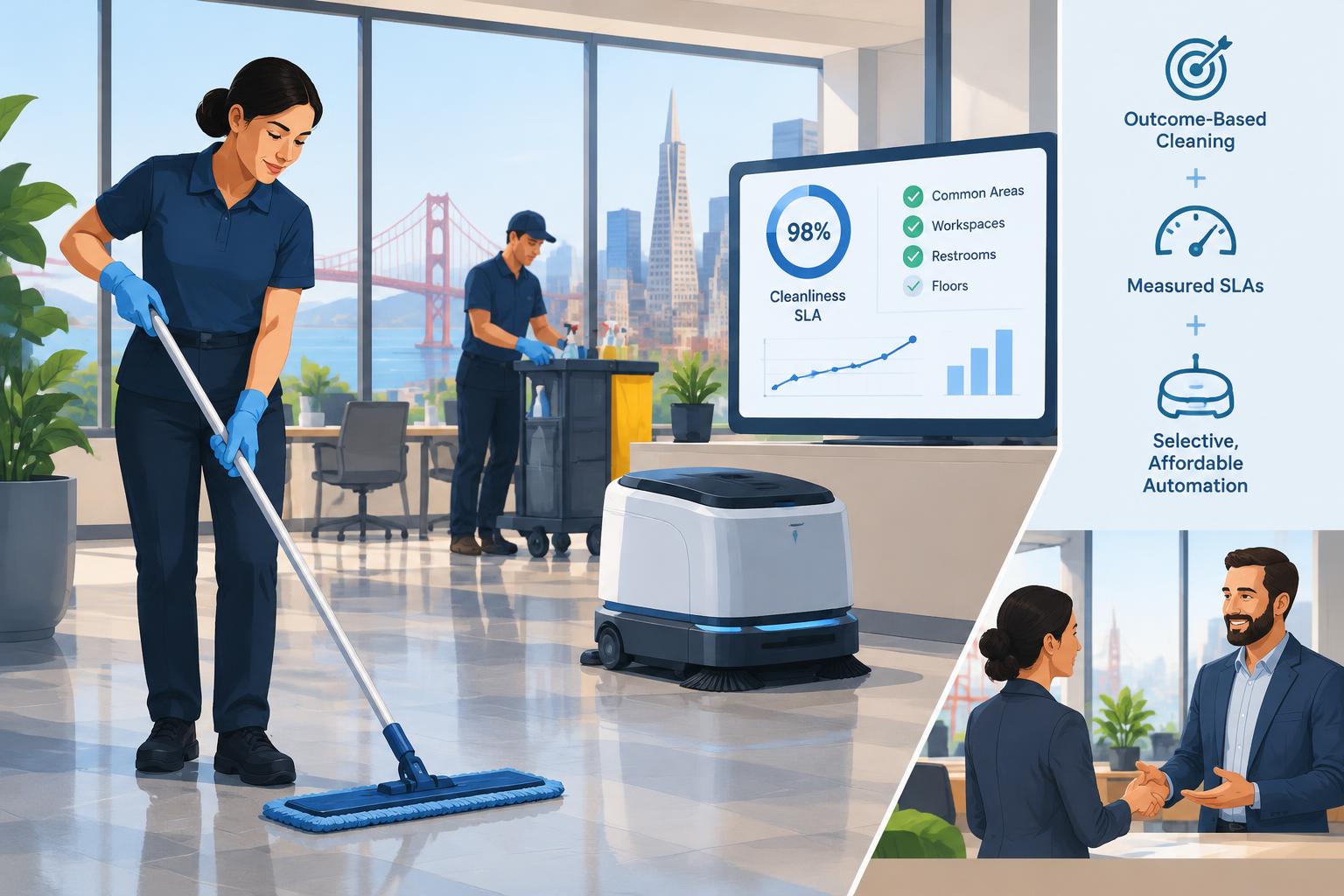
The Bid You Keep Losing Isn't About Price
Small janitorial contractors in San Francisco know the frustration: you submit a competitive bid, your crew does solid work, and you still lose the renewal to a larger firm. The reason is rarely your hourly rate. According to trade coverage analyzed by CleanScan's 2026 industry trends report, the first question in a commercial cleaning renewal is increasingly about documentation — what records you can produce, what the facility manager can forward to procurement, and what your audit trail looks like.
That shift matters enormously for small contractors. Facility managers are now expected to justify vendor selections internally. If your competitor hands procurement a tidy digital evidence packet and you hand over a paper sign-in sheet, the outcome is predictable — regardless of who actually cleaned better.
The good news is that outcome-based contract structures reward results, not just labor hours. For a small, agile provider of office cleaning in San Francisco, CA, that's an opportunity — if you build the right systems before your next bid cycle.
What "Outcome-Based" Actually Means in Practice
Input-based contracts bill by hours worked and headcount deployed. Outcome-based contracts bill against documented service-level agreements (SLAs): restrooms inspected and signed off by a specific time, floor care completed to a measurable standard, complaint response windows met or exceeded.
The practical difference is accountability flowing in both directions. You commit to a measurable result; the client commits to paying for that result rather than policing your hours. For providers of commercial cleaning in San Francisco, CA, this framing can justify higher per-visit rates when you can prove consistent delivery.
CleanScan's report notes that "paper logs are getting filtered out of enterprise procurement in favor of digital audit trails." That doesn't mean you need an enterprise software budget — it means you need some form of timestamped, retrievable record for every completed task.
Defining SLAs You Can Actually Hit
The fastest way to lose an outcome-based contract is to over-promise. Start with two or three measurable commitments you are confident your team can meet on every shift: restroom check completion within the first 30 minutes of a shift, floor care on a documented weekly rotation, and a 24-hour response window for client-reported issues. Build your SLA language around what you already reliably deliver, then expand from there as you add staff or tools.
Selective Automation: Spend Where It Counts
The 2026 Building Service Contractor Benchmarking Survey from Cleaning & Maintenance Management found that labor accounts for more than 60% of total operating costs for 42% of BSC respondents — and that recruiting qualified cleaning staff remains the most pressing challenge for 75% of contractors surveyed. Automation doesn't eliminate that problem, but it can reduce its impact.
"Selective" is the operative word for small contractors. Full robotic floor scrubbers or enterprise IoT sensor networks carry price tags that don't pencil out for a 10-person operation. However, affordable entry points exist: QR-code-based task-verification apps, digital inspection checklists on a tablet, and automated client-report scheduling can each be adopted incrementally for modest monthly costs.
Where Automation Earns Its Keep
Prioritize automation at the points of highest client visibility and highest documentation risk. Restroom inspections and floor care in San Francisco, CA are two areas where timestamped photo verification pays dividends — a client who receives a timestamped photo log of their polished lobby floor after each service visit has little reason to question whether the work was done.
Window cleaning and post-construction or move-in/move-out turnovers are similarly high-stakes: the results are visible and the liability for missed items is real. A simple before-and-after photo workflow costs almost nothing to implement and creates exactly the kind of audit trail that procurement departments are beginning to require.
Building the Bid Packet That Wins
Once your SLAs are defined and your documentation process is running, the bid packet becomes your competitive edge. Assemble a one-page summary of your service commitments, a sample monthly inspection report, and — if you have completed similar scopes — a anonymized record of SLA performance from a comparable account. You are not selling hours; you are selling a repeatable, provable outcome.
The CMM Benchmarking Survey found that 71% of new BSC accounts are won by replacing an incumbent contractor. That means almost every competitive bid you enter involves a client who is already dissatisfied with someone. The question they are trying to answer is: will this contractor be different, and how do I know? A documented SLA framework answers that question before the first shift.
Pricing the Outcome Model Correctly
Switching to outcome-based pricing requires honest internal math. Calculate your true cost per visit — labor, supplies, travel, administrative overhead — before setting SLA-based rates. Build in a small buffer for the compliance tasks (photo logging, report generation) that now form part of your service. Undercutting on price while absorbing documentation overhead is a path to margin erosion, not growth.
Positioning for Long-Term Growth in San Francisco
San Francisco's commercial real estate market includes a dense mix of Class A office buildings, healthcare-adjacent facilities, and high-turnover tenant spaces — all environments where outcome documentation is increasingly expected. Contractors who establish SLA-based systems now are building a repeatable sales process, not just winning one account.
The BSC survey projects that 85% of contractors expect gross revenue growth in 2026, with the majority targeting commercial office and property management as their primary growth verticals. For a small janitorial services provider in San Francisco, CA, competing in that environment without a documentation-first approach means competing purely on price — the least defensible position in any market.
Invest in systems before you need them. By the time a major facility manager asks for your audit trail, it is too late to build one retroactively.
Ready to Put This Into Practice?
If you are a building manager or business owner in the San Francisco area looking for a commercial cleaning partner that delivers measurable results — not just labor hours — reach out to C&A Janitorial Service Inc to discuss your facility's needs. Describe your space, your current pain points, and the service standards that matter most to you, and we will work with you to build a cleaning scope that is documented, accountable, and built to last.
About this illustration
This editorial image was created with AI. It is not a photograph of an actual customer, property or completed service.