Win Outcome-Based Cleaning Contracts in San Francisco
Facility managers are now asking for documentation before price. Here's how small commercial cleaning companies in San Francisco can win outcome-based contracts using data, hybrid schedules, and affor
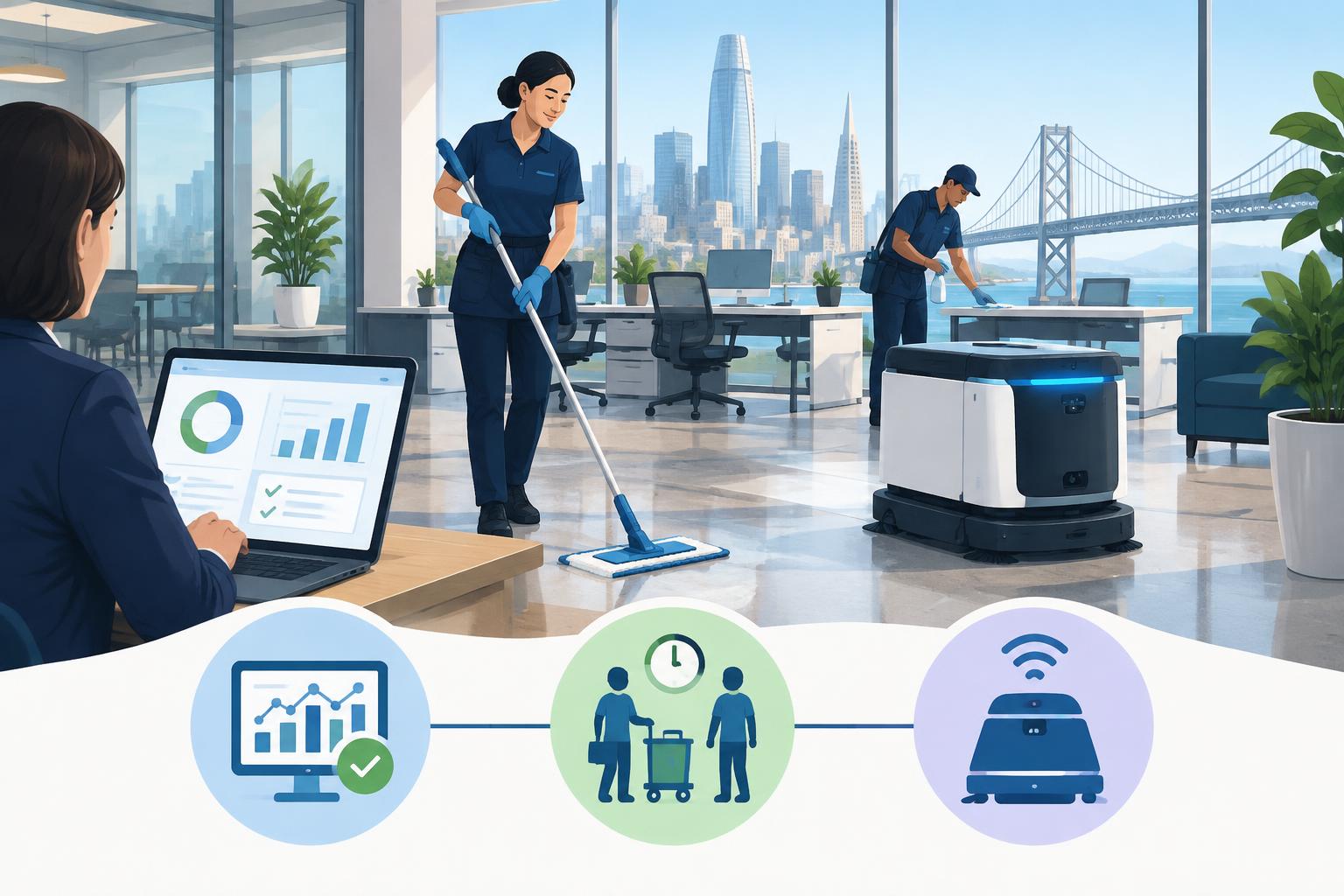
How Small Commercial Cleaners Can Win Outcome-Based Contracts in San Francisco
Facility managers in San Francisco are no longer opening contract renewals with a single question about price. They're asking for the documentation packet first — the audit trail, the service records, the proof. For small janitorial services companies competing in a market dominated by large national players, this shift is both a threat and a genuine opening.
Understanding what's driving that change, and acting on it before your next RFP, is where the competitive edge lives.
Why the Contract Conversation Has Changed
For years, commercial cleaning bids were won on hours worked and headcount deployed. That model rewarded whoever could staff cheapest, not whoever cleaned best. The shift toward outcome-based service-level agreements (SLAs) changes the scoring criteria entirely.
According to CleanScan's 2026 industry trend coverage, proof of service is now a baseline RFP requirement in regulated sectors — not a differentiator. Healthcare, education, and food service accounts increasingly expect documented cleaning evidence as a condition of qualification, not a bonus feature. That same pressure is moving into standard commercial office contracts as Class A buildings integrate occupancy and building-health data.
For a small commercial cleaning company serving office buildings in San Francisco, CA, this is clarifying news: you can no longer win on relationships alone, but you can win on documentation quality that larger, bureaucratic competitors are slow to produce.
Build the Audit Trail Before the RFP Arrives
The companies losing outcome-based contracts aren't losing because their cleaning is poor — they're losing because they can't prove it wasn't. Paper logs, verbal check-ins, and end-of-month invoices don't survive enterprise procurement review.
Digital audit tools don't require a large capital investment. QR-code-based scan verification, timestamped mobile check-ins, and simple inspection apps can all be deployed by small teams. The goal is a documented record that a facility manager can forward to procurement without editing — exactly what CleanScan's research identifies as the new baseline expectation.
Start with your highest-value accounts. Implement a consistent sign-off protocol for each service visit: area completed, time completed, technician ID. That paper-to-digital transition, even at a basic level, repositions your company in the next contract conversation.
What to Document for Each Service Visit
- Area or zone serviced, with timestamped confirmation
- Inspection checklist results (pass/fail per task)
- Any flagged issues and how they were resolved
- Supervisor sign-off or photo verification for high-touch zones
Use Day-Porter and Hybrid Schedules to Compete on Flexibility
One structural advantage small janitorial services companies have over large nationals is scheduling agility. A hybrid model — combining traditional after-hours deep cleaning with daytime day-porter coverage — lets you meet SLA requirements without simply adding headcount.
Day porters address real-time facility needs: restroom restocking, spill response, lobby upkeep between meetings, and lobby-level window cleaning touchups. This visible, responsive presence is something many facility managers value but rarely specify in RFPs until a vendor demonstrates it. Offering a hybrid proposal positions your company as outcome-focused rather than task-focused.
This approach is especially relevant for office cleaning in San Francisco, CA, where many Class B and Class C buildings are operating with reduced occupancy but still require consistent, presentable common areas. A day-porter component lets you right-size labor to actual building use rather than defaulting to fixed overnight schedules.
Affordable Robotics: What's Realistic for Small Operators
Autonomous floor-scrubbing machines and AI-guided vacuums are no longer exclusively enterprise tools. Entry-level commercial robotic floor care units have dropped in price significantly, making them accessible to small operators who want to reduce labor hours on low-complexity, high-frequency tasks — particularly floor care in large open-plan offices, lobbies, and corridors.
The Opora Supply 2026 State of Commercial Cleaning report puts the median janitor wage at $17.71/hour (May 2025), with employer benefit costs adding roughly 29.9% on top of that. In a market like San Francisco where labor costs run above national medians, deploying a robotic unit for repetitive floor passes — even one machine — can free a technician for higher-skill tasks like post-construction cleaning, detail work, or inspection duties that support your SLA documentation.
The honest limitation: robotics work best in predictable, obstacle-light environments. They are not a replacement for trained staff on move-in and move-out cleaning, detailed restroom sanitation, or anything requiring judgment. Use them to protect margin on routine floor care, not to reduce headcount across the board.
Pricing and Market Reality: Know the Numbers Going In
Small operators often underprice outcome-based contracts because they're quoting from habit rather than market data. The Opora 2026 report documents a contract price band of $0.16–$0.29 per square foot per month across commercial building types — a wide range that reflects scope, building class, and the documentation burden the contractor agrees to carry.
Outcome-based SLAs sit at the higher end of that band, because you are selling verified results, not just access to a crew. If your current bids are priced at the floor of that range, you are likely absorbing SLA risk without charging for it. Review whether your pricing reflects the actual cost of compliance: the time to document, inspect, report, and resolve issues within SLA windows.
Understanding that 89% of firms in this industry employ fewer than 20 workers — but that 43.1% of all industry workers are concentrated in just 294 large firms — frames the competitive landscape clearly. Small operators hold the majority of firms but compete for a fraction of the revenue. Outcome-based contracting is one of the few structural levers that shifts that equation in favor of demonstrably high-performing small teams.
Take the Next Step with C&A Janitorial Service Inc
If your commercial cleaning business serves San Francisco and you're preparing for a contract renewal or a competitive RFP, C&A Janitorial Service Inc is ready to talk through what an outcome-based service model looks like in practice — from documentation protocols to day-porter scheduling to floor care strategy. Reach out directly to discuss your facility's needs and get a straightforward conversation about what the right scope of service looks like for your building.
About this illustration
This editorial image was created with AI. It is not a photograph of an actual customer, property or completed service.